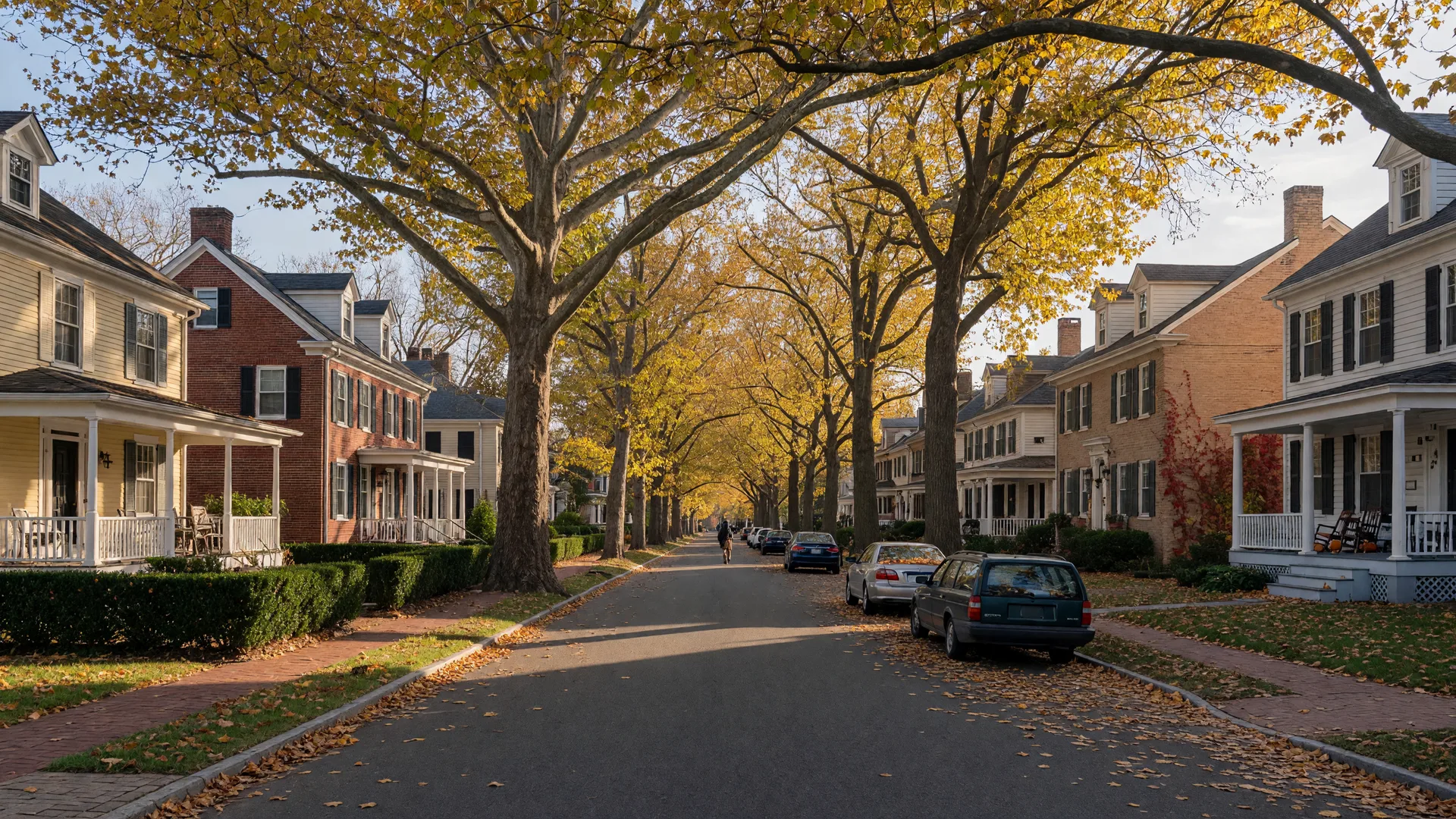
The best way to understand Moorestown is on foot. The town's nickname, the "Town of Quality," is not just a slogan: it is a promise written into the architecture of the Moorestown Historic District, a National and State Register-listed neighborhood where homes built in the 1700s stand a short walk from modern Main Street shops. This self-guided walking tour takes you through the district's most important landmarks, from the Community House to the 1740 sycamore tree, with local coffee and dining stops along the way.
The route is roughly one mile and takes about an hour at a relaxed pace, longer if you stop for coffee or lunch. It is entirely walkable, mostly flat, and family-friendly, and it works in any season. You can follow it start to finish or pick the stops that interest you most.
Here is how to walk the historic heart of Moorestown and see why so many people fall in love with this town.
Where Should the Walking Tour Start?
Start at the Moorestown Community House at 16 East Main Street, the town's social and cultural anchor since 1926. Built in the English Gothic style and designed by the Philadelphia architects Karcher & Smith, the Community House was funded by Eldridge Reeves Johnson, the founder of the Victor Talking Machine Company, who gave the money as an anonymous gift in 1923. Today it hosts clubs, nonprofits, a ballroom, meeting rooms, a garden room, and more than 10,000 square feet of event space, and it has received New Jersey Historic Preservation Fund grants to keep it in shape.
The Community House sits right off Main Street, so it is the natural gateway to the district. Grab a coffee first at one of the downtown cafes and you have everything you need for a leisurely loop. For a full rundown of shops and dining on and around Main Street, the Things to Do in Moorestown guide is a handy companion.
What Is the Historic Sycamore Tree and Where Is It?
As you head east along Main Street, keep an eye out for one of Moorestown's oldest living landmarks: a historic sycamore tree planted around 1740. It has stood through the American Revolution, the founding of the Victor Talking Machine Company, and generations of Moorestown families, and it remains one of the most photographed trees in town.
The sycamore is a reminder that Moorestown's history is not confined to museums. Old homes, old trees, and old streets all tell the story of a community that has valued permanence and quality for nearly three centuries. If you are considering a home in this area, the Best Neighborhoods in Moorestown guide explains which parts of the district and town suit different lifestyles.
Which Historic Homes Should You Look For on Main Street?
Main Street itself is lined with contributing properties in the historic district. Matlack's Store at 101 East Main Street and the New Jersey Bell Building at 105 East Main Street are two of the most recognizable commercial landmarks, while the Samuel Haines House at 124 East Main Street is a fine example of the residential architecture that defined the street in the 1800s.
Just off Main Street, High Street holds one of the district's true treasures: the Smith-Cadbury Mansion at 12 High Street. Built in or before 1738, it is one of Moorestown's oldest houses and now serves as the museum of the Historical Society of Moorestown. It was listed on the National Register of Historic Places in 1976, and it is well worth a stop for anyone curious about how Moorestown's earliest residents actually lived.
For a deeper look at what owning one of these older homes is really like, from inspections to upkeep, read the guide to buying a historic home in Moorestown.
Where Can You See Moorestown's Revolutionary War History?
Moorestown played a real part in the American Revolution, and several homes from that era still stand. On Chester Avenue, the Joshua Humphreys House at 111 Chester Avenue and the nearby Hessian House are both tied to the Revolutionary War period and are among the most historically significant buildings in the district.
The Moorestown Friends Meeting House at the corner of Main Street and Chester Avenue is another essential stop. Moorestown's Quaker heritage runs deep, and the meeting house reflects the values of simplicity and community that shaped the town from its earliest days. The Quaker influence is one of the reasons Moorestown developed the orderly, tree-lined character it is known for today.
If you want to understand how all of this history fits together, the About Moorestown page tells the fuller story of the town's founding and growth.
What Are the Best Side Streets to Stroll?
The real charm of the district is on its side streets. Second Street, Maple Avenue, and Chester Avenue are lined with stately colonials, Victorians, and Craftsman-style homes set back behind mature trees and tidy lawns. In the fall, these streets put on a canopy of gold and amber that makes the walk feel like a postcard.
These are also the streets that make Moorestown's neighborhoods so desirable. They are quiet, walkable, and close to downtown, which is why so many buyers specifically look for homes in the historic core. For a sense of the different communities that make up the town, the Living in Moorestown pillar guide is the best place to start.
Where Should You Stop for Coffee or Lunch Mid-Tour?
A walking tour is better with good coffee. On Main Street, French Press at 2 East Main Street is a charming French-inspired cafe known for its espresso and fresh croissants, while Pie Lady Cafe at 9 East Main Street is a beloved institution famous for its house-made pastries and pies. If you want beans to take home, Cowabunga Coffee Roasters on Nixon Drive is a local roastery that supplies several of the town's cafes.
For lunch, the downtown is full of family-run options, from Passariello's to Carollo's Little Italy, and a short drive reaches favorites like Luna y Sol Mexican Restaurant and Cockadoodle Dan's. For a curated list of where locals actually eat, browse the Local Businesses directory.
If you would rather keep moving, the Moorestown Walking Trails guide lists scenic paths nearby, including the loop around Strawbridge Lake, for a longer outing.
Is the Historic District Walkable Year-Round?
Yes. The district is compact, flat, and mostly shaded, which makes it comfortable in spring and fall, pleasant on mild summer evenings, and still doable in winter with a warm coat. Each season changes the character of the walk: cherry blossoms and dogwoods in spring, deep green canopies in summer, gold and amber in fall, and quiet, snow-dusted streets in winter.
The Community House and the Smith-Cadbury Mansion also host events and open houses throughout the year, so it is worth checking the calendar before you go. For upcoming happenings, the Community Events page keeps a running list of what is on in town.
How Long Should You Plan for the Walk?
Plan for about an hour if you walk the full loop without stopping, and two to three hours if you linger over coffee, lunch, or a visit to the Smith-Cadbury Mansion. There is no wrong pace. The district rewards slow walking and looking up, because many of the best details, from a Federal-era doorway to a Victorian porch bracket, are easy to miss at speed.
Comfortable shoes, a phone for photos, and a reusable water bottle are all you really need. Parking is available on Main Street and the side streets, and the walk itself is free.
Why Take the Time to Walk Moorestown's History?
Because Moorestown's history is not a museum exhibit, it is the neighborhood you would actually live in. The same streets that hosted Revolutionary War-era homes and the founder of the Victor Talking Machine Company are the streets where families walk to school, grab coffee, and gather at the Community House today. Walking the district is the quickest way to feel why this town earned the name the Town of Quality.
Whether you are a longtime resident, a new neighbor, or someone thinking about moving here, the historic district is the best introduction to Moorestown. Take the walk, enjoy the town, and you will understand what makes this community special.